


<–back to Glossary of Sports Terms
Basketball Terms
3 point line: Line that separates the 2-point area from the 3-point area. In the WNBA, it is 20.625 feet from the basket. All shots made behind the 3-point line are worth 3 points. If the player is stepping on the 3-point line when she shoots, it is worth 2-points.
Backboard: a piece of basketball equipment. It is a raised vertical board with a basket attached. It is made of a flat, rigid piece of material, often plexiglass. It is usually rectangular, but can also be oval. The backboard helps the shooter aim at the basket, and it gives the shooter something to bounce the ball off of in order to increase the ball’s chance of going into the basket.
Back screen: An off the ball screen, usually done while the defender has her back to the screener.
Baseline: The line beneath both baskets that shows the “out of bounds” on each side of the court.
Block: occurs when a defensive player legally deflects an attempted shot from an offensive player. The defender must not touch the offensive player’s hands or otherwise a foul is called. In order to be legal, the block must occur while the shot is traveling upward or at its apex
Bounce pass: the passer bounces the ball crisply about two-thirds of the way from his own chest to the receiver. The ball strikes the court and bounces up toward the receiver. The bounce pass takes longer to complete than the chest pass, but it is also harder for the opposing team to intercept (kicking the ball deliberately is a violation). Thus, players often use the bounce pass in crowded moments, or to pass around a defender.
Buzzer-beater: To make a shot right before end of the quarter, half, or game.
Center: Normally the tallest person on the team, does the tip-off, handles the middle of the court.
Chest pass: The ball is passed directly from the passer’s chest to the receiver’s chest. A proper chest pass involves an outward snap of the thumbs to add velocity and leaves the defense little time to react.
Cut: Offensive player moving without the ball to get open.
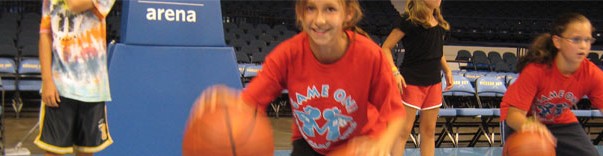
Dribble: Using one hand at a time, the ball is bounced onto the floor. The player can stay still or move across the court while dribbling. Once the player stops dribbling she cannot start again until another a teammate touches the ball.
Double dribble: is a violation in which a player dribbles the ball, clearly holds it with a combination of either one or two hands (while either moving or stationary), and then proceeds to dribble again without first either attempting a shot or passing off to a teammate. Double dribbling can also occur if a player tries to dribble using both hands at the same time
Double Team: When two people defend one player.
Downtown: The area being the 3-point line
Elbow: The intersection of the free throw line and the side of the key.
Free throw: unopposed attempts to score points from a restricted area on the court (the free throw line; informally known as the foul line), and are generally awarded after a foul on the shooter by the opposing team. Each successful free throw is worth one point.
Free throw line: Line on the court that players shooting free throws stand behind. It is located 15 feet from the basket.
Foul: an infraction of the rules concerning illegal personal contact with an opponent and/or unsportsmanlike behavior. A personal foul is the most common type of foul in basketball. Due to the nature of the game, personal fouls occur on occasion and are not always regarded as unsportsmanlike. However, a contact foul involving excessive or unjustified contact is classed as an unsportsmanlike foul
High Post: Free throw area at the elbow.
Jump shot: an attempt to score a basket by jumping, usually straight up, and in mid-jump, propelling the ball in an arc into the basket. It is accomplished by the player bringing her elbow up until it is aligned with the hoop, then sent towards the hoop in a high arc. It is considered the easiest shot to make from a distance. The purposes of the jump are to make it more difficult for the defender to block, and to put more power behind the shot.
Layup: a two-point shot attempt made by leaping from below, laying the ball up near the basket, and using one hand to bounce it off the backboard and into the basket. The layup is considered the most basic shot in basketball. When doing a layup, the player lifts the outside foot, or the foot away from the basket.
Low Post: The block at the edge of the key even with the front of the rim.
Man-to-man: a type of defensive tactic in which each player is assigned to defend and follow the movements of a single player on offense. Often, a player guards his counterpart (e.g. center guarding center), but a player may be assigned to guard a different position. The strategy is not rigid however, and a player might switch assignment if needed, or leave his own assignment for a moment to double team an offensive player.
Mid Post: Area between the high and low post.
Overhead pass: used to pass the ball over a defender. The ball is released while over the passer’s head.
Paint/Lane: Area under the basket, between the free throw line and base line. The offense cannot be in the paint for more than 3 seconds or they must turn the ball over to the defense.
Pick and roll: an offensive play in which a player sets a screen (pick) for a teammate handling the ball and then slips behind the defender (rolls) to accept a pass
Point Guard: Primary ball handler on the court, (play maker).
Post player: Normally on the taller side, spends most of their time on the blocks and moving through the key.
Power Dribble: Two handed, short dribble, usually in line with the middle of your body, make a wide base with your feet. Normally used in the low post.
Push the Ball: To dribble or pass up the court quickly; the offense has an advantage on the fast break.
Power Forward: This player plays in the post/high post area. Usually can shoot mid-range jump shots and also do post moves.
Set the pick: Another way of saying ‘set the screen’. (An offensive player blocks off a defensive player in order to make space for the point guard.)
Shooting Guard: This player is usually the best shooter on the team and can also handle the ball when the point guard is not open.
Small Forward: This player usually plays on the wing on offense and can drive to the basket but also can shoot.
Strong side: The side of the court that the ball is on.
Traveling: a violation of the rules that occurs when a player holding the ball moves one or both of her feet illegally. Most commonly, a player travels by illegally moving his pivot foot or taking too many steps without dribbling the ball.
Turnover: When the offense commits a violation OR the ball is stolen by the defense. Now the defense has possession of the ball.
Weak side: The side of the court that the ball is not on; also called help side on defense.
Wing: The intersection of the three-point line and where the free throw line extended would meet.
Zone: a type of defense, used in many team sports, which is the alternative to man-to-man defense; instead of each player guarding a corresponding player on the other team, each defensive player is given an area known as a “zone” to cover